
Can democracy function during war?
Ukrainians prove it can

Issue #35
In the central square of Kharkiv, young people stand holding cardboard signs. “Bring back Fedorov”, “Effective ministers should keep working” and “What the hell?” are among the messages visible in the small crowd. Ukrainians have always been creative with their protest signs.
“This is just demoralizing. If they really do remove the defense minister, it will demoralize the whole nation,” says Natalia, one of the protesters. “Right now we’re on the rise. Morale has been climbing – since around January we’ve felt strong, moving forward.” She adds: “And now it feels really scary.”
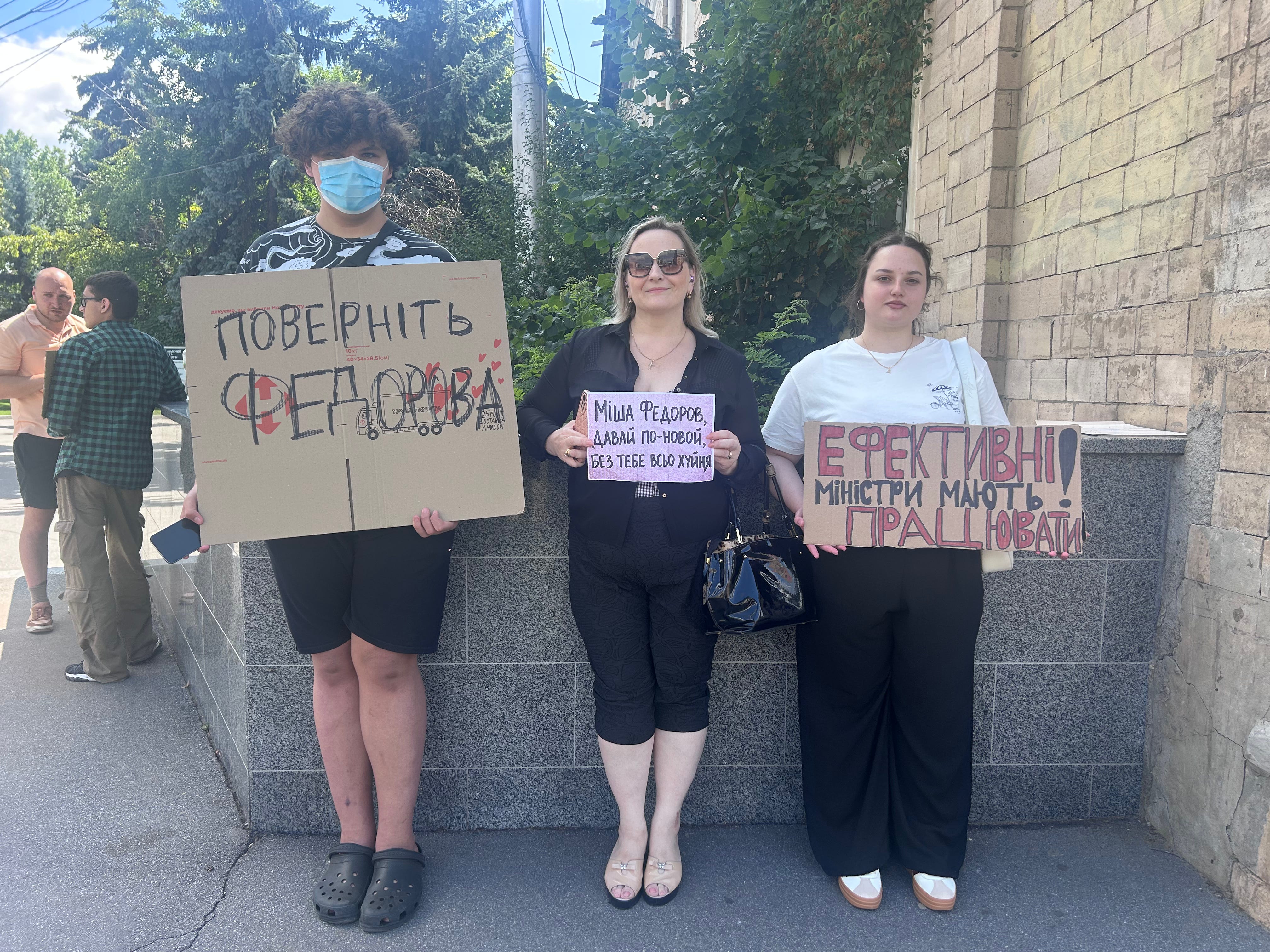
Natallia, in the center, with other protesters. Kharkiv, July 16, 2026
Like in many Ukrainian cities, people in Kharkiv took to the streets after President Volodymyr Zelenskyy decided to remove Defense Minister Mykhailo Fedorov from his post. Ukrainians view Fedorov’s reforms positively, especially in the area of drones. He became closely linked with pushing new technology onto the battlefield – and Ukrainians want drones fighting and defend their country, and protect more people. “I think soldiers there started to feel a bit more protected. Maybe I’m wrong, but I want to believe it,” Natalia continues.
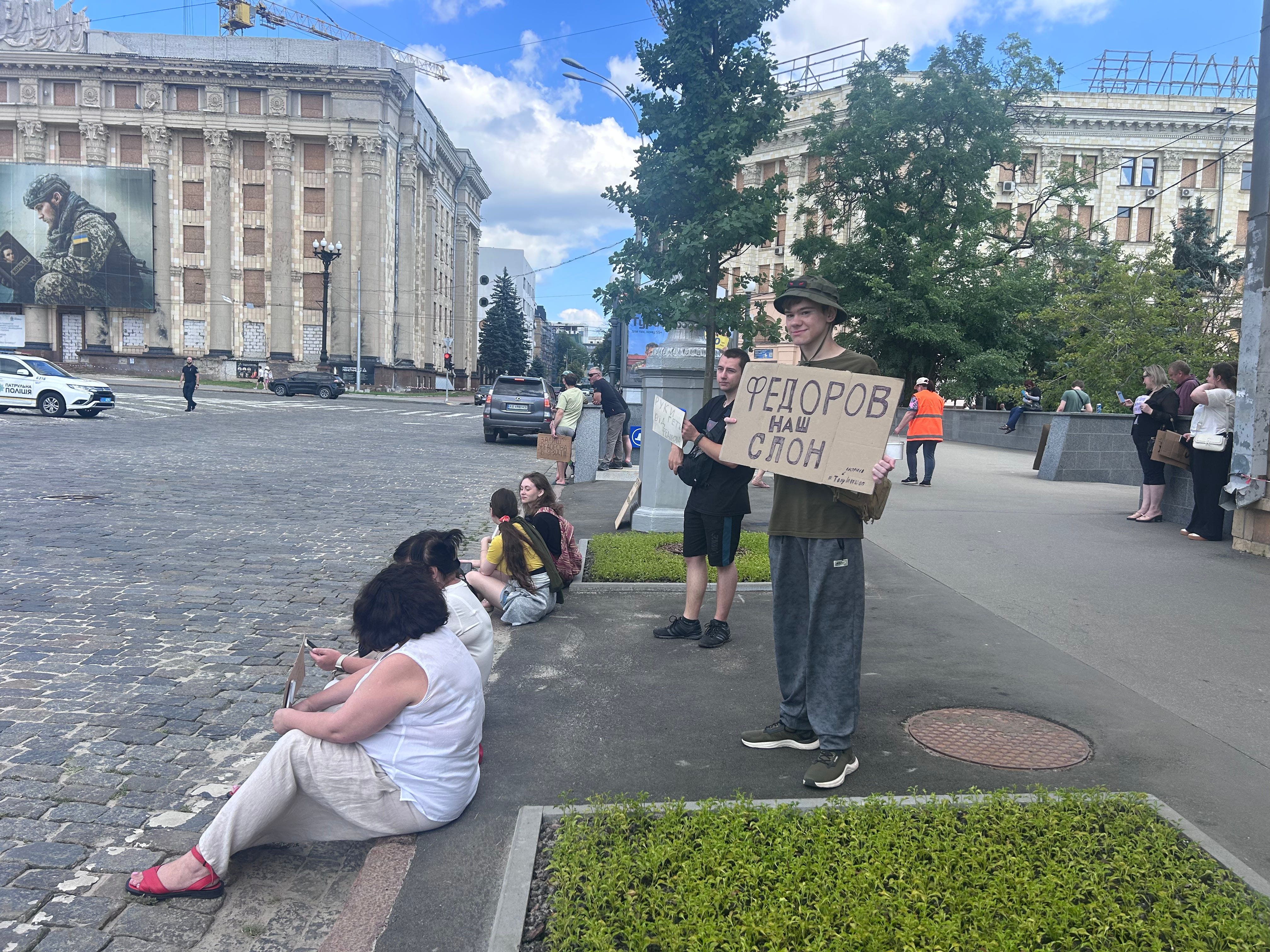
A group of protesters with signs in support of Defense Minister Fedorov. Kharkiv, July 16, 2026
Her voice is something of a quintessence of the Ukrainian voices at the protests that swept the country’s streets on July 16, following the removal of Defense Minister Fedorov.
It’s not the first time during the war Ukrainians have taken to the streets to defend an institution they believe is working, or to show the government what the red lines are not to cross. Last year, it was the independence of the country's anti-corruption bodies, NABU and SAPO, that brought thousands out – from Kyiv to Lviv to Odesa – after parliament moved to strip them of their independence. That pressure worked. Zelenskyy reversed course within days.
Yet, here we’re again – a need to defend innovative approach against the old, obsolete and highly questionable schemes. Ukrainians today joke that something is off about July, since last year’s protests in support of the anti-corruption bodies also began in July, in 2025.


Cardboard signs held by the protesters. “No to sovok” can be read on one of them. Sovok is a colloquial, derogatory term for the Soviet system and mentality, so the meaning is not to Sovietism
The pattern is always the same – a decision is made, or about to be made, in Kyiv’s power offices, and within hours, ordinary Ukrainians – students, office workers, veterans, parents with newborns – are standing in central squares with cardboard hand-lettered signs, refusing to accept it and reminding the government who’s in charge here.
This is remarkable. Ukraine is fighting the largest war in Europe since 1945. Martial law is in effect, and no elections can be held under it. And yet the basic muscle of democracy – public dissent, civic pressure, accountability – keeps flexing.
And it shows up in small things and different perspectives, too. Local councils in frontline areas still meet, even if often underground. Independent media keeps criticizing the government when needed, and exposes its cases of corruption, or human rights violations in the army. In frontline cities, small investigative outlets keep calling officials out. Citizens still organize fundraisers not just for drones, but for schools, for stray animals, for help rebuilding someone’s damaged home. A man in Kharkiv said that parents from his daughter’s class collect money to pay rent for an underground space, so children can somehow meet in person and socialize, since schooling in the city is online. The Khartia brigade organizes meetings with citizens to explain how air defense in the city works, or how electronic warfare systems work, and city residents don’t shy away from asking uncomfortable questions.
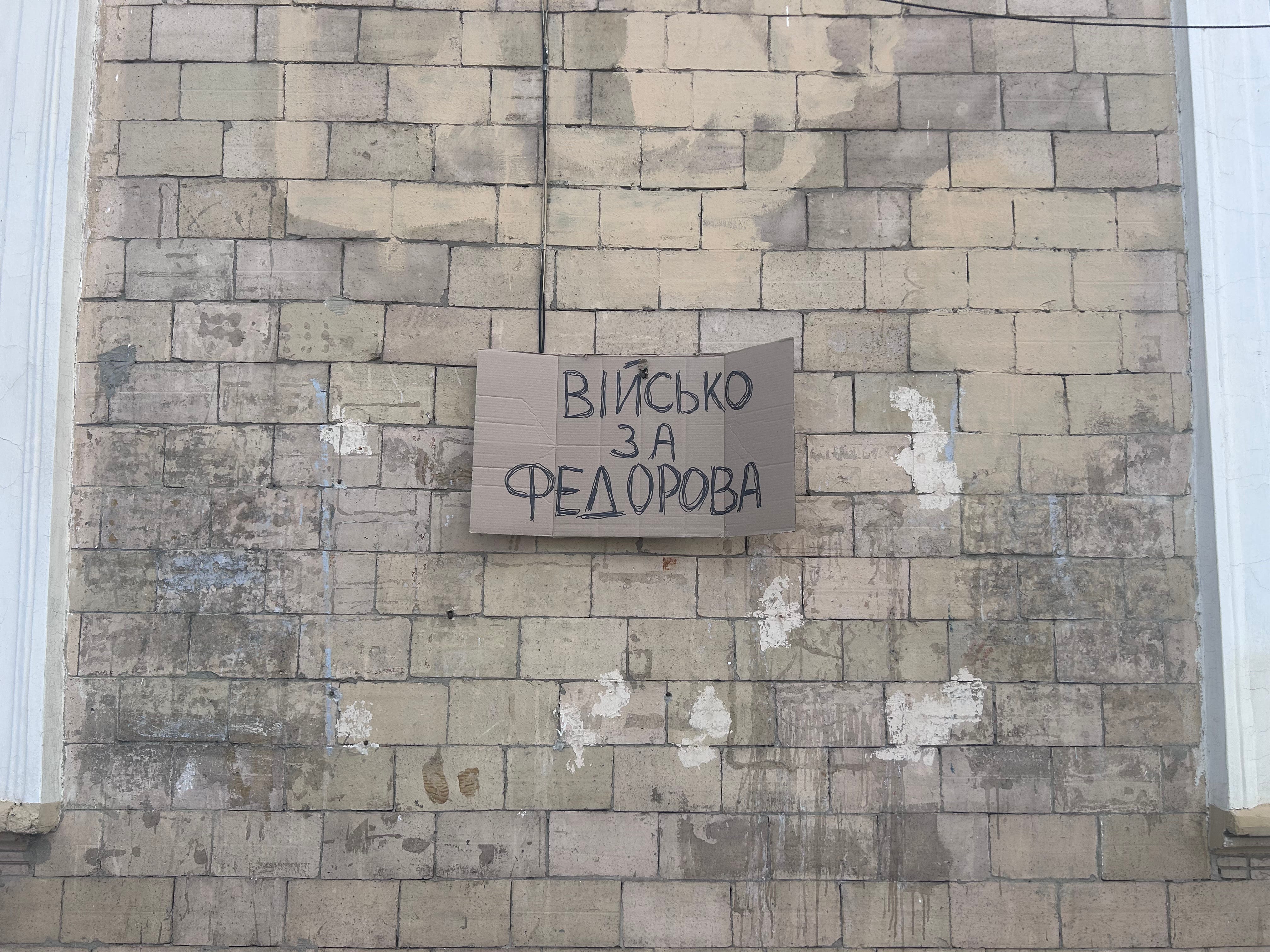
A cardboard sing on the wall of a building: “The military stands with Fedorov." Kharkiv, July 16, 2026
When Ukrainians are asked, or people express surprise, about why they do things that the state should be doing, they often answer – “We are the state.” This is a kind of historical trait of Ukrainian society – namely, its horizontal structure, where it resembles a network, with people uniting into groups based on interests or needs to solve a particular problem. Now, Ukrainian society resembles an anthill divided into separate groups, where everyone does something for the country during the war – from creating big organisations that offer psychological support to veterans to small initiatives that rescue people from frontline areas, just naming a few. All tasks arise from individual initiatives rather than state directives. And when the authorities threaten to knock that anthill off course, people organize and go to remind the government that it’s heading the wrong way. And no martial law will stand in the way of that, because if Ukraine is fighting a totalitarian Russian dictatorship, that means the country wants to live by democratic principles – principles that must also be preserved within the country itself. To fight anti-democracy from outside, you need to remain a democracy on the inside. By taking to the streets to protest, Ukrainians maintain that line.
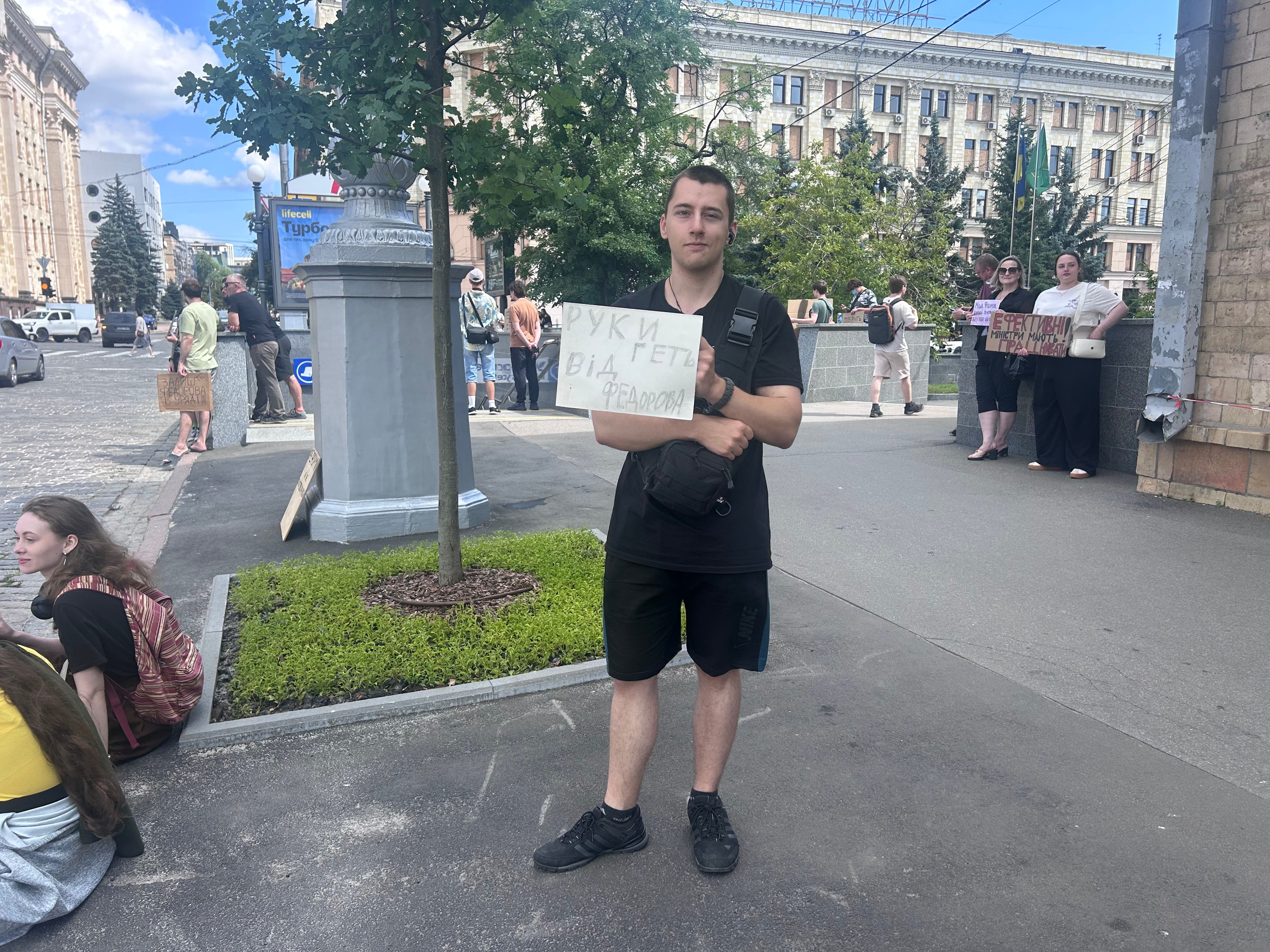
One of the protesters holds a sign that reads “Hands off Fedorov.” Kharkiv, July 16, 2026
So, for example, when protesters in Kharkiv go down into the metro during air raid alerts, and then come back up to continue protesting, that is proof of just how important it is for this society to remain a democracy. Life during war in Ukraine is not paused – it is compressed – grief and protest and normalcy all happening in the same day, sometimes the same square.
“So this would be a big mistake – for Zelensky, in my opinion, and for parliament as a whole, if they approve it,” Natalia says of the Fedorov decision. “We stand with Fedorov. Bring him back.”
Whether or not the government reverses course this time, the protest itself is the point. Ukrainians have made clear, twice in two years, that no wartime consolidation of power goes unquestioned – that trust in institutions has to be earned continuously, not assumed because there’s a war on.
Independent journalism takes time and resources. If 50 readers contribute €8/month, I can do more of it. Consider to make one time donation!


…democracy doesn’t have a “on and off” switch, it’s either democracy or autocracy
💪🏻🇺🇦 Proud to share this DNA!