
Dnipro is grieving again
Oil money funds the strikes. And Russia is already burying the evidence

Issue #29
Russia keeps pouring drones and missiles in Ukraine. Dnipro, in southeastern Ukraine, is grieving again. The city declared April 24 a Day of Mourning – one more in a countless series, after Russian strikes killed 8 civilians over the past ten days.
"My wife was killed – she never had a chance," – those were the words a young man told local media right after a Russian drone strike on a residential building in Dnipro took the life of his young wife. The couple was sleeping, as local media reconstructions of the events show. Oleksandr survived by chance, as the drone hit the side where his wife was sleeping. The man said that after the impact, the floor collapsed under his feet. He climbed out onto the balcony, then pulled himself up onto a satellite dish, and then squeezed into the gap between two stairwell entrances, where he hung until rescuers pulled him down. He waited about 20 minutes barefoot and in the robe he had been sleeping in. “I was supposed to die there too,” Oleksandr told local media Suspilne. The night raid left 3 killed and dozens injured.
These last weeks Russia ramped up its attacks on Ukrainian homes. It’s not as though Russian forces hadn’t been attacking civilians in the weeks prior - it happens almost every day, particularly along the front line, in cities like Zaporizhzhia, or in Donbas area, where artillery and aerial bombs add to Russia’s bloody daily death toll. Yet in April 2026, Ukrainians deal with a rapidly growing grim body count. The data from April 16 to April 26 clearly shows the human cost of Russian air raids over ten days.
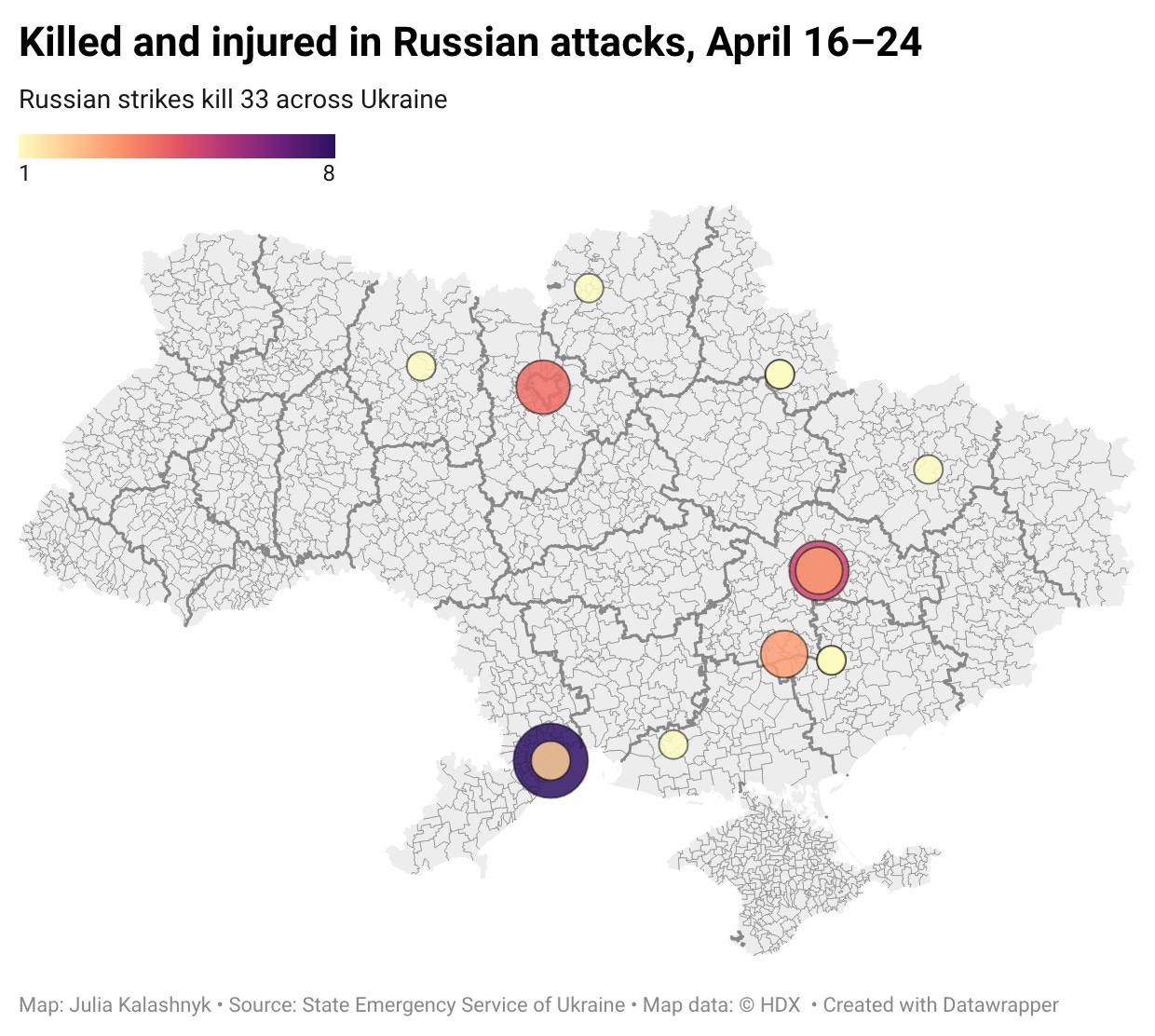
33 killed, 153 injured from April 16 - 24. The chart only shows days where deaths were recorded — injuries alone are not included. Data source: State Emergency Service of Ukraine
In Dnipro, 8 people were killed across April 16 and 23. On that same April 16, a Russian assault on Odesa claimed 8 lives – two more would follow in the coming days. In Kyiv, that day, the strikes killed 4, among them a child, and left 21 injured. In just ten days, Russia killed 33 people across Ukraine.
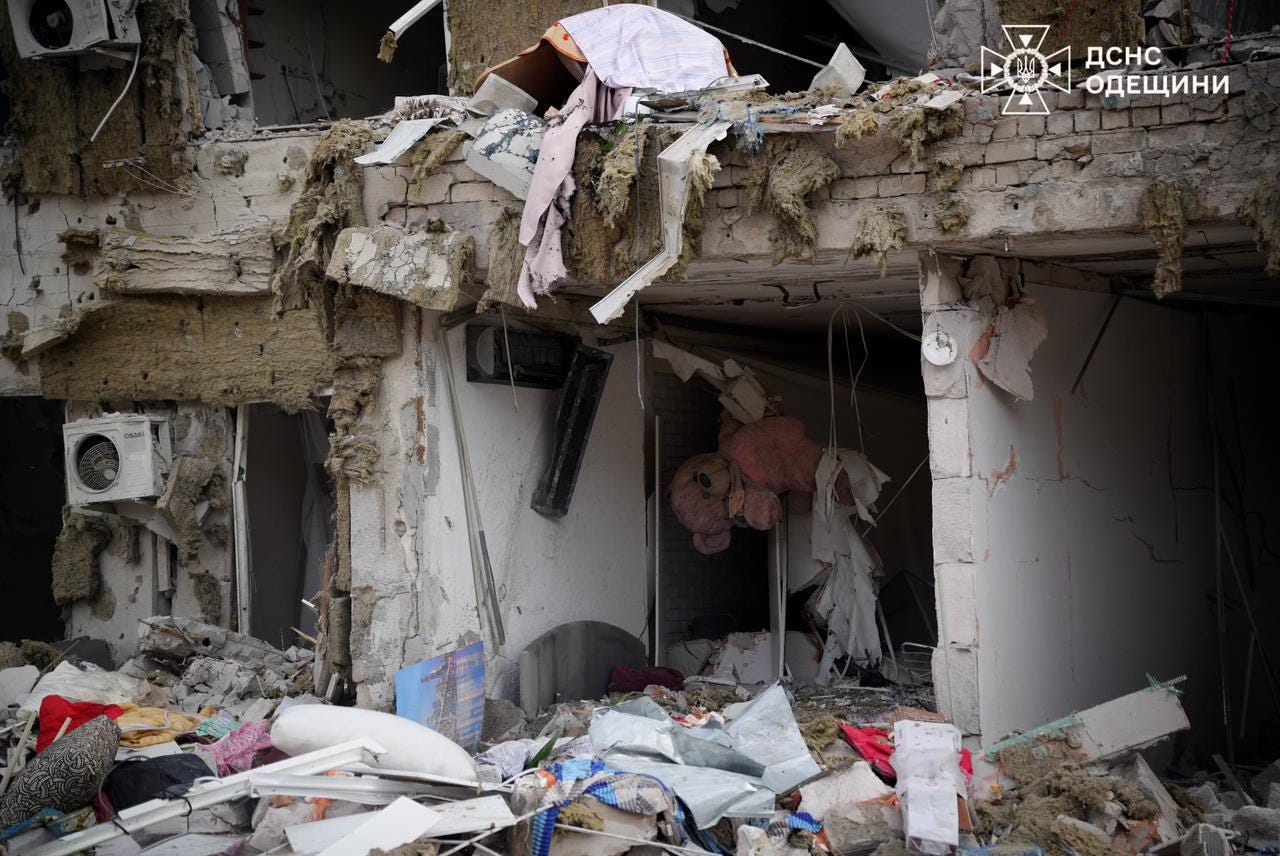
An apartment in Odesa after another Russian strike. Photo: State Emergency Service of Ukraine
Yet outside Ukraine’s borders, not all actions seem aligned with stopping Russia’s war machine. Behind each strike is a supply chain of weapons, of political decisions, and, primarily, of money.
Just days ago, the US eased sanctions on Russian oil again, rolling back an initial full ban in the wake of the Strait of Hormuz blockade. It doesn’t take much to see that oil and gas revenues remain Russia’s primary bankroller for its war on Ukraine and hybrid warfare across Europe. And that’s not all. Ukrainian intelligence has warned that Russia is sharing intelligence with Iran, while European intelligence believes Moscow is supplying Tehran with drones – a development that came as no surprise to US intelligence either. CNN earlier reported, citing sources, that Russia had been feeding Iran intelligence on the locations and movements of American troops, ships and aircraft. Even so, Russia’s backing of Iran did nothing to delay sanctions relief for Russian oil already at sea. Russia is reaping up to $150 million in additional daily budget revenue from oil sales, according to media reports. Earlier, Volodymyr Zelensky said that more than 110 vessels from Moscow’s shadow fleet are currently at sea, carrying over 12 million tons of Russian oil that can once again be sold without consequences thanks to sanctions relief. “That’s $10 billion – resources that convert directly into new strikes on Ukraine,” he said.
Ukraine has taken on this counterbalance largely on its own – and has been doing so at least since last summer. The country has stepped up strikes on Russia’s energy infrastructure as the Kremlin keeps cashing in on the oil price surge that followed the war with Iran, and on sanctions relief. Refineries and terminals inside Russia are being systematically targeted by Ukrainian drones, disabling at least 40% of Russian exports, alongside tanker seizures from other countries.
Ukraine struck the Tuapse oil refinery in Krasnodar Krai, in southern Russia, for nearly a week – and the site is still burning. The attack dealt a serious blow to Russia’s oil industry, as the Tuapse refinery, oriented primarily toward export, has effectively shut down. According to media reports, the smoke plume stretches more than 300 kilometers. A “black rain” is falling on the city, and local residents are complaining that Putin has said nothing, while local authorities are pretending nothing is happening.
Ukraine has adopted the tactic of striking Russian refineries to at least partially choke off the flow of petrodollars into Russia’s war machine – money the Kremlin funnels straight to the front or into producing the missiles that rain down on Ukrainian homes.
Even more counterbalance is also expected from the EU’s 20th sanctions package. It has already shown some bite – targeting Russia’s energy revenues and the third-country channels Moscow has long relied on to circumvent restrictions. One of the package’s main focuses is Russian oil income and the shadow fleet: 46 tankers have been added to the sanctions list, barred from EU ports, bringing the total number of sanctioned Russian vessels to 632. Operations with the ports of Murmansk and Tuapse – already knocked out by Ukrainian strikes – are now prohibited, along with an Indonesian oil terminal that had been helping Russia skirt the restrictions.
But will any of this stop Russia? With sanctions tightening on one side and easing on the other, the Kremlin is receiving no clear signal that there are any real obstacles to continuing its war on Ukraine. Russia has even started floating the idea that the US invited it to rejoin the G20 – and Trump told reporters it would welcome that. So far, the message of serious consequences for Russia remains undelivered. Meanwhile, Russia keeps launching missiles at Ukrainian homes, as it has throughout these past ten days – and the more time passes, the more opportunity it has to erase the evidence of its war crimes.
Just recently satellite images, cited by Mariupol officials in exile, show that a mass grave site near the city has been destroyed – disguised as road repairs. The site held victims of the 2022 siege, when at least 22,000 civilians were killed, though the real toll may be higher. With the city still occupied, the evidence is being erased faster than it can be documented – and the chances of identifying victims or holding anyone accountable are fading with it.
Independent journalism takes time and resources. Help me fund my next reporting trip – if 50 readers contribute €8/month, I can make it happen.
Love you clear detailed writing. From Canada, I appreciate knowing how the invasion resistance is going, and pray for a just peace soon.
Take care.